
International Cyber Expo International Cyber Expo
  • About Us
Tuesday, 21 July, 2026
IT Security Guru
International Cyber Expo
  • Home
  • Features
  • Insight
  • Channel News
  • Events
    • Most Inspiring Women in Cyber 2026
  • Topics
    • Cloud Security
    • Cyber Crime
    • Cyber Warfare
    • Data Protection
    • DDoS
    • Hacking
    • Malware, Phishing and Ransomware
    • Mobile Security
    • Network Security
    • Regulation
    • Skills Gap
    • The Internet of Things
    • Threat Detection
    • AI and Machine Learning
    • Industrial Internet of Things
  • Multimedia
  • Product Reviews
  • About Us
No Result
View All Result
  • Home
  • Features
  • Insight
  • Channel News
  • Events
    • Most Inspiring Women in Cyber 2026
  • Topics
    • Cloud Security
    • Cyber Crime
    • Cyber Warfare
    • Data Protection
    • DDoS
    • Hacking
    • Malware, Phishing and Ransomware
    • Mobile Security
    • Network Security
    • Regulation
    • Skills Gap
    • The Internet of Things
    • Threat Detection
    • AI and Machine Learning
    • Industrial Internet of Things
  • Multimedia
  • Product Reviews
  • About Us
No Result
View All Result
IT Security Guru
No Result
View All Result

Government agencies: Under attack, but ignorant to cyber security

by The Gurus
August 21, 2015
in This Week's Gurus
Share on FacebookShare on Twitter

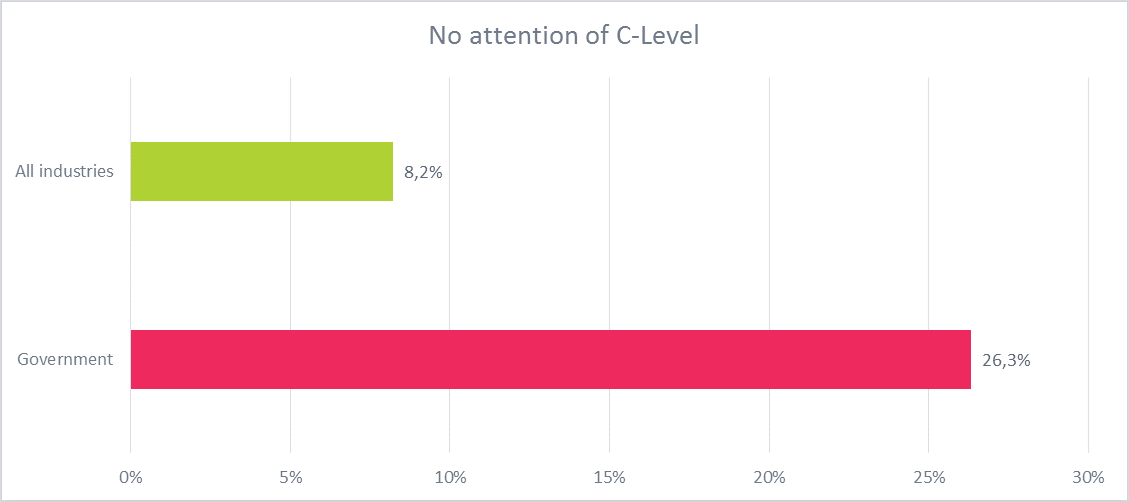
One of the results of the KuppingerCole Digital Risk and Awareness Survey that sprung to my awareness has been the massive difference in C-level awareness for cyber security in government agencies, compared to businesses. While an overall average of 8.2% of all respondents said that they have no C-level awareness for cyber security, the level of non-awareness in government agencies was at 26.3%.
The positive interpretation is that there is C-level awareness for cyber security already in 3 out of 4 government agencies. On the other hand, the situation is obviously worse than in businesses.
Taking incidents such as Wikileaks, the Snowden revelations, or the recent OPM breach, there is no reason assuming that government agencies are less under attack from internals and externals than businesses – in contrast. Simply said: There should be a 100% awareness of the C-levels of agencies (even while they might be titled differently, e.g. minister etc.) nowadays.
But what happens in contrast? Current German legislation e.g. excludes government agencies from the scope of the IT Security Law, focusing only on “critical industries”. Not that a well-working government isn’t critical or attacks against secret services or military can’t cause massive issues…
Realistically seen, the level of security implemented in many government agencies appears being horrible. The breadth of the OPM hack is one example. The German Bundestag hack is another one, with a chaotic reaction, shedding a spotlight on the archaic level of their security concepts and operations. And even today I can’t understand why Manning; a rather low ranked soldier, had access to such incredible amounts of documents. Classification is one thing, additional access control based on the “need to know” principle are a different one.
A frequently heard argument is the lack of skilled people, as e.g. the FBI recently complained. Yes, we have a skill gap, and low-paying government agencies suffer more than businesses. But that an excuse for failing in cyber security in government agencies. The state has to accept that there is a need for funding cyber security, both on the people and technology side.
It is time that all leading people in government agencies understand and take their accountability for improving cyber resilience. Awareness of accountability is the first step towards funding the required activities and distributing responsibilities within the organization.
Furthermore, it is about leveraging cyber resilience to a level that is adequate to the type of attacks in particular government agencies are facing. A relevant part of what today commonly is called APTs (Advanced Persistent Threats) is performed by nation-state attackers and targeted at government agencies, military (and critical infrastructures) of other countries. Modern, elaborated attacks require modern, elaborated defense and response. Old school approaches only relying on firewalls and traditional IT security are no longer sufficient – it requires advanced analytical capabilities such as RTSI (Real Time Security Intelligence), well thought-out user and access management, and more.
Ignorance doesn’t solve cyber security issues. Time to act. Now.
DRSA_C_level_non_awareness_of_information_security
Martin Kuppinger is Founder of the independent Analyst Company KuppingerCole and as Principal Analyst responsible for the KuppingerCole research. In his 25 years of IT experience he has already written more than 50 IT-related books and is known as a widely-read columnist and author of technical articles as well as reviews and is also a well-established speaker and moderator at seminars and congresses. His interest in Identity Management dates back to the 80s, when he also gained considerable experience in software architecture development. Over the years, he added several other fields of research, including virtualization, cloud computing, overall IT security, and others. Having studied economies, he combines in-depth IT knowledge with a strong business perspective.

Tags: Cyber AttackCyber SecuritycybersecurityEdward SnowdenFBIHackhackedHackerhackinginformation securityinfosecit securityKuppinger ColeMartin KuppingerSnowdenWikiLeaks
ShareTweet
Previous Post

Now Ashley Madison hackers reveal 'CEO's emails and source code'

Next Post

Why the new NSA revelations remain particularly important for companies

Recent News

What Does the Cyber Industry Want to See From the New UK Government?

What Does the Cyber Industry Want to See From the New UK Government?

July 20, 2026
Purple Logo, capitalised letters: SALT.

Salt Security tackles AI governance challenge with 100 pre-built agentic security policies

July 20, 2026
New Continuous Runtime Security Validation service aims to strengthen fintech cyber resilience

New Continuous Runtime Security Validation service aims to strengthen fintech cyber resilience

July 20, 2026
Scams Now Drive Almost Half of All Malware Detections as Attackers Weaponise Everyday Trust

Scams Now Drive Almost Half of All Malware Detections as Attackers Weaponise Everyday Trust

July 20, 2026

Eskenzi PR banner ad

The IT Security Guru offers a daily news digest of all the best breaking IT security news stories first thing in the morning! Rather than you having to trawl through all the news feeds to find out what’s cooking, you can quickly get everything you need from this site!

Our Address: 10 London Mews, London, W2 1HY

Follow Us

© 2015 - 2026 IT Security Guru - Website Managed by Dessol

  • About Us
Manage Consent
To provide the best experiences, we use technologies like cookies to store and/or access device information. Consenting to these technologies will allow us to process data such as browsing behavior or unique IDs on this site. Not consenting or withdrawing consent, may adversely affect certain features and functions.
Functional Always active
The technical storage or access is strictly necessary for the legitimate purpose of enabling the use of a specific service explicitly requested by the subscriber or user, or for the sole purpose of carrying out the transmission of a communication over an electronic communications network.
Preferences
The technical storage or access is necessary for the legitimate purpose of storing preferences that are not requested by the subscriber or user.
Statistics
The technical storage or access that is used exclusively for statistical purposes. The technical storage or access that is used exclusively for anonymous statistical purposes. Without a subpoena, voluntary compliance on the part of your Internet Service Provider, or additional records from a third party, information stored or retrieved for this purpose alone cannot usually be used to identify you.
Marketing
The technical storage or access is required to create user profiles to send advertising, or to track the user on a website or across several websites for similar marketing purposes.
  • Manage options
  • Manage services
  • Manage {vendor_count} vendors
  • Read more about these purposes
View preferences
  • {title}
  • {title}
  • {title}
No Result
View All Result
  • Home
  • Features
  • Insight
  • Channel News
  • Events
    • Most Inspiring Women in Cyber 2026
  • Topics
    • Cloud Security
    • Cyber Crime
    • Cyber Warfare
    • Data Protection
    • DDoS
    • Hacking
    • Malware, Phishing and Ransomware
    • Mobile Security
    • Network Security
    • Regulation
    • Skills Gap
    • The Internet of Things
    • Threat Detection
    • AI and Machine Learning
    • Industrial Internet of Things
  • Multimedia
  • Product Reviews
  • About Us

© 2015 - 2026 IT Security Guru - Website Managed by Dessol