
Eskenzi PR ad banner Eskenzi PR ad banner
  • About Us
Thursday, 4 June, 2026
IT Security Guru
Eskenzi PR banner
  • Home
  • Features
  • Insight
  • Channel News
  • Events
    • Most Inspiring Women in Cyber 2026
  • Topics
    • Cloud Security
    • Cyber Crime
    • Cyber Warfare
    • Data Protection
    • DDoS
    • Hacking
    • Malware, Phishing and Ransomware
    • Mobile Security
    • Network Security
    • Regulation
    • Skills Gap
    • The Internet of Things
    • Threat Detection
    • AI and Machine Learning
    • Industrial Internet of Things
  • Multimedia
  • Product Reviews
  • About Us
No Result
View All Result
  • Home
  • Features
  • Insight
  • Channel News
  • Events
    • Most Inspiring Women in Cyber 2026
  • Topics
    • Cloud Security
    • Cyber Crime
    • Cyber Warfare
    • Data Protection
    • DDoS
    • Hacking
    • Malware, Phishing and Ransomware
    • Mobile Security
    • Network Security
    • Regulation
    • Skills Gap
    • The Internet of Things
    • Threat Detection
    • AI and Machine Learning
    • Industrial Internet of Things
  • Multimedia
  • Product Reviews
  • About Us
No Result
View All Result
IT Security Guru
No Result
View All Result

New DevOps Research From Sonatype Reveals Changing Attitudes Toward Application Security

by The Gurus
March 23, 2017
in Editor's News
Share on FacebookShare on Twitter

Sonatype, the leader in software supply chain automation, has announced the results of its 2017 DevSecOps Community Survey which was conducted in February.  There were 2,292 IT professionals that participated in the online survey which revealed that mature development organisations ensure automated security is woven into their DevOps practice, early, everywhere, and at scale. Analysis of responses also found that IT organisations continue to struggle with breaches as nearly a 50% increase was recorded between Sonatype’s 2014 and 2017 survey.
The adoption of DevOps around the world is evidenced by 67% of survey respondents describing their practices as very mature or of improving maturity. Where traditional development and operations teams see security teams and policies slowing them down (47%), DevOps teams have discovered new ways to integrate security at the speed of development. Only 28% of mature DevOps teams believe they are being slowed by security requirements.
Other key findings from the survey include:
Development plays an active, early role in application security

  • Developers are taking more responsibility for security with 24% of all respondents saying it’s a top concern while in mature DevOps organisations that number rises to 38%.
  • 58% of mature DevOps teams have automated security as part of Continuous Integration (CI) practices compared to 39% of all survey participants.

For DevOps teams, security controls are increasingly automated throughout the development lifecycle

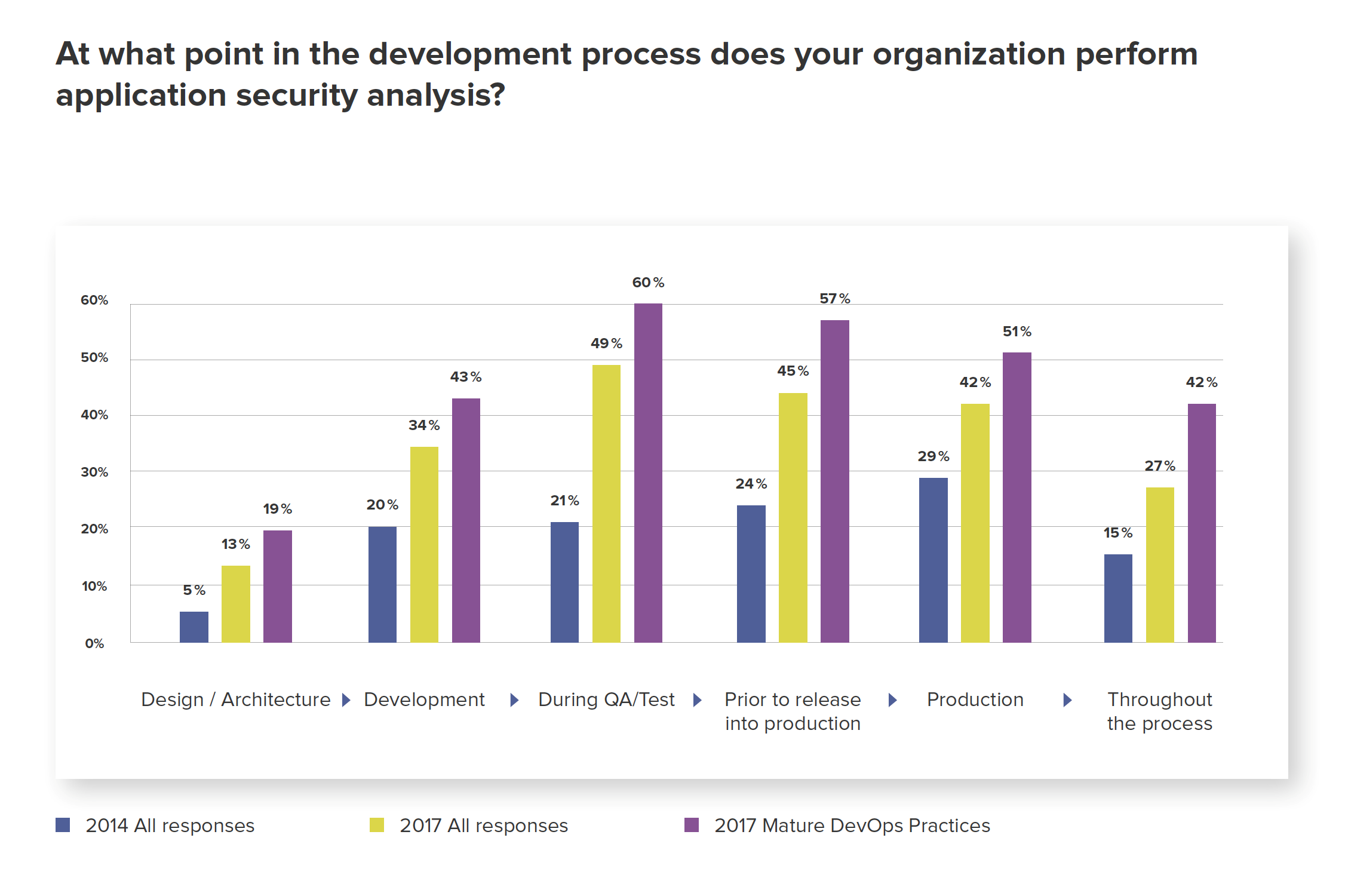
  • 42% of mature DevOps organisations perform application security analysis at every stage of the software delivery life cycle (SDLC). This number shrinks to just 27% when all survey respondents are counted.

Automated security practices allow developers to keep pace with the speed and scale of innovation

  • 88% of survey respondents indicated that security was a top concern when deploying containers, yet only 53% leverage security solutions to address this problem.
  • 35% of organisations keep a complete software bill of materials to help them track down new open source vulnerabilities faster (e.g., Commons-Collection, Struts2).
  • 85% of those surveyed from highly mature DevOps practices received some form of application security training, ensuring awareness of secure coding practices. In immature DevOps practices, 30% received no training.

“As evidenced by this year’s survey results, organisations everywhere are now transforming their development from waterfall-native to DevOps-native tools and processes,” said Wayne Jackson, CEO, Sonatype. “Along the way, they are coming to grips with one simple fact: DevOps is not an excuse to do application security poorly; rather it is an opportunity to do application security better than ever.”
View the full survey

Tags: CybersecurityTechnology
ShareTweet
Previous Post

Alleged C.I.A. Hacking Documents Reinforce Need for SSL Traffic Inspection

Next Post

When is a phishing email not a phishing email? The taxonomy of malicious emails

Recent News

Nagomi Control Brings CTEM Into Action

IT Security Guru picks for Infosecurity Europe 2026

June 1, 2026
Nine in Ten Security Leaders Concerned About AI-Generated Code Risks as Salt Security Launches New Governance Tool

Nine in Ten Security Leaders Concerned About AI-Generated Code Risks as Salt Security Launches New Governance Tool

June 1, 2026
Acumen Cyber and AttackIQ Partner to Strengthen Cyber Defense Validation

Acumen Cyber and AttackIQ Partner to Strengthen Cyber Defense Validation

May 29, 2026
Check Point Launches AI Agents That Think Like Attackers as Autonomous Exploitation Reaches Critical Threat Level

Check Point Launches AI Agents That Think Like Attackers as Autonomous Exploitation Reaches Critical Threat Level

May 28, 2026

The IT Security Guru offers a daily news digest of all the best breaking IT security news stories first thing in the morning! Rather than you having to trawl through all the news feeds to find out what’s cooking, you can quickly get everything you need from this site!

Our Address: 10 London Mews, London, W2 1HY

Follow Us

© 2015 - 2024 IT Security Guru - Website Managed by Dessol

  • About Us
Manage Consent
To provide the best experiences, we use technologies like cookies to store and/or access device information. Consenting to these technologies will allow us to process data such as browsing behavior or unique IDs on this site. Not consenting or withdrawing consent, may adversely affect certain features and functions.
Functional Always active
The technical storage or access is strictly necessary for the legitimate purpose of enabling the use of a specific service explicitly requested by the subscriber or user, or for the sole purpose of carrying out the transmission of a communication over an electronic communications network.
Preferences
The technical storage or access is necessary for the legitimate purpose of storing preferences that are not requested by the subscriber or user.
Statistics
The technical storage or access that is used exclusively for statistical purposes. The technical storage or access that is used exclusively for anonymous statistical purposes. Without a subpoena, voluntary compliance on the part of your Internet Service Provider, or additional records from a third party, information stored or retrieved for this purpose alone cannot usually be used to identify you.
Marketing
The technical storage or access is required to create user profiles to send advertising, or to track the user on a website or across several websites for similar marketing purposes.
  • Manage options
  • Manage services
  • Manage {vendor_count} vendors
  • Read more about these purposes
View preferences
  • {title}
  • {title}
  • {title}
No Result
View All Result
  • Home
  • Features
  • Insight
  • Channel News
  • Events
    • Most Inspiring Women in Cyber 2026
  • Topics
    • Cloud Security
    • Cyber Crime
    • Cyber Warfare
    • Data Protection
    • DDoS
    • Hacking
    • Malware, Phishing and Ransomware
    • Mobile Security
    • Network Security
    • Regulation
    • Skills Gap
    • The Internet of Things
    • Threat Detection
    • AI and Machine Learning
    • Industrial Internet of Things
  • Multimedia
  • Product Reviews
  • About Us

© 2015 - 2024 IT Security Guru - Website Managed by Dessol