Eskenzi PR ad banner Eskenzi PR ad banner
  • About Us
Wednesday, 3 June, 2026
IT Security Guru
Eskenzi PR banner
  • Home
  • Features
  • Insight
  • Channel News
  • Events
    • Most Inspiring Women in Cyber 2026
  • Topics
    • Cloud Security
    • Cyber Crime
    • Cyber Warfare
    • Data Protection
    • DDoS
    • Hacking
    • Malware, Phishing and Ransomware
    • Mobile Security
    • Network Security
    • Regulation
    • Skills Gap
    • The Internet of Things
    • Threat Detection
    • AI and Machine Learning
    • Industrial Internet of Things
  • Multimedia
  • Product Reviews
  • About Us
No Result
View All Result
  • Home
  • Features
  • Insight
  • Channel News
  • Events
    • Most Inspiring Women in Cyber 2026
  • Topics
    • Cloud Security
    • Cyber Crime
    • Cyber Warfare
    • Data Protection
    • DDoS
    • Hacking
    • Malware, Phishing and Ransomware
    • Mobile Security
    • Network Security
    • Regulation
    • Skills Gap
    • The Internet of Things
    • Threat Detection
    • AI and Machine Learning
    • Industrial Internet of Things
  • Multimedia
  • Product Reviews
  • About Us
No Result
View All Result
IT Security Guru
No Result
View All Result

9 In 10 Cybersecurity Leaders Fear Risk Of Third-Party Attacks,

They Lack Confidence In The Supply Chain.

by The Gurus
November 12, 2019
in Security News
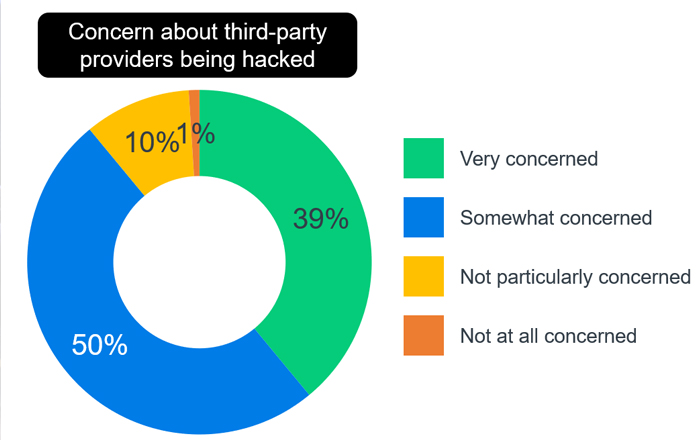
Concerns about Third-party
Share on FacebookShare on Twitter

An overwhelming number of cybersecurity professionals (89%) have expressed concerns about the third-party managed service providers (MSPs) they partner with being hacked, according to new research from the Neustar International Security Council.

While most organisations reported working with an average of two to three MSPs, less than a quarter (24%) admitted to feeling very confident in the safety barriers they have in place to prevent third-party contractors from violating security protocols. Along with this concern, security professionals expressed a desire to switch cloud providers, with over half (53%) claiming they would if they could.

These threat levels were also apparent in Neustar’s International Cyber Benchmarks Index, which NISC began mapping trends in 2017, the most recent index revealed an 18-point increase over the two-year period.

Aside from third-party threats, security professionals ranked distributed denial of service (DDoS) attacks as their greatest concern (22%), closely followed by system compromise (20%) and ransomware (19%). Insider threat remained bottom of the list, with 29% seeing it as the least concerning.

In light of continued fears around DDoS attacks, organisations outlined their most recent security focus to be on increasing their ability to respond to DDoS threats, with 57% admitting to having been on the receiving end of an attack in the past. In the most recent data set collected and analysed by NISC, enterprises were most likely to take between 60 seconds and 5 minutes to initiate DDoS mitigation.

“Regardless of size or sector, every organisation relies on third-party service providers to support and enable their digital transformation efforts. Whether it’s a business intelligence tool, cloud platform or automation solution, the number of MSPs businesses work with is only set to increase, as enterprises continue to chase agility and find new ways to attract customers,” said Rodney Joffe, Chairman of NISC, Senior Vice President, Security CTO and Fellow at Neustar. “However, by multiplying the number of digital links to an organisation, you also increase the potential for risk, with malicious actors finding alternative ways to infiltrate your networks.”

“While businesses should adopt their own, always-on approach to security, it’s essential that they are also questioning the security of their whole digital network, including the third parties they work with. Missed connections or weak links can cause lasting damage to an organisation’s bottom line, leaving no room for error,” Joffe added.

Methodology

Survey participants in July 2019 comprise 314 professionals from across six EMEA and US markets. All are in senior positions within their organisations and able to provide informed opinions about cybersecurity issues, including how these are impacting their enterprise and the wider business community.

ShareTweet
Previous Post

10 Steps To Get Started In Cybersecurity Careers: What High-Achievers Do While Others Don’t.

Next Post

Teenage Hacker Arrested for Selling Unreleased Songs From Top Artists.

Recent News

Nagomi Control Brings CTEM Into Action

IT Security Guru picks for Infosecurity Europe 2026

June 1, 2026
Nine in Ten Security Leaders Concerned About AI-Generated Code Risks as Salt Security Launches New Governance Tool

Nine in Ten Security Leaders Concerned About AI-Generated Code Risks as Salt Security Launches New Governance Tool

June 1, 2026
Acumen Cyber and AttackIQ Partner to Strengthen Cyber Defense Validation

Acumen Cyber and AttackIQ Partner to Strengthen Cyber Defense Validation

May 29, 2026
Check Point Launches AI Agents That Think Like Attackers as Autonomous Exploitation Reaches Critical Threat Level

Check Point Launches AI Agents That Think Like Attackers as Autonomous Exploitation Reaches Critical Threat Level

May 28, 2026

The IT Security Guru offers a daily news digest of all the best breaking IT security news stories first thing in the morning! Rather than you having to trawl through all the news feeds to find out what’s cooking, you can quickly get everything you need from this site!

Our Address: 10 London Mews, London, W2 1HY

Follow Us

© 2015 - 2024 IT Security Guru - Website Managed by Dessol

  • About Us
Manage Consent
To provide the best experiences, we use technologies like cookies to store and/or access device information. Consenting to these technologies will allow us to process data such as browsing behavior or unique IDs on this site. Not consenting or withdrawing consent, may adversely affect certain features and functions.
Functional Always active
The technical storage or access is strictly necessary for the legitimate purpose of enabling the use of a specific service explicitly requested by the subscriber or user, or for the sole purpose of carrying out the transmission of a communication over an electronic communications network.
Preferences
The technical storage or access is necessary for the legitimate purpose of storing preferences that are not requested by the subscriber or user.
Statistics
The technical storage or access that is used exclusively for statistical purposes. The technical storage or access that is used exclusively for anonymous statistical purposes. Without a subpoena, voluntary compliance on the part of your Internet Service Provider, or additional records from a third party, information stored or retrieved for this purpose alone cannot usually be used to identify you.
Marketing
The technical storage or access is required to create user profiles to send advertising, or to track the user on a website or across several websites for similar marketing purposes.
  • Manage options
  • Manage services
  • Manage {vendor_count} vendors
  • Read more about these purposes
View preferences
  • {title}
  • {title}
  • {title}
No Result
View All Result
  • Home
  • Features
  • Insight
  • Channel News
  • Events
    • Most Inspiring Women in Cyber 2026
  • Topics
    • Cloud Security
    • Cyber Crime
    • Cyber Warfare
    • Data Protection
    • DDoS
    • Hacking
    • Malware, Phishing and Ransomware
    • Mobile Security
    • Network Security
    • Regulation
    • Skills Gap
    • The Internet of Things
    • Threat Detection
    • AI and Machine Learning
    • Industrial Internet of Things
  • Multimedia
  • Product Reviews
  • About Us

© 2015 - 2024 IT Security Guru - Website Managed by Dessol