
Eskenzi PR ad banner Eskenzi PR ad banner
  • About Us
Wednesday, 3 June, 2026
IT Security Guru
Eskenzi PR banner
  • Home
  • Features
  • Insight
  • Channel News
  • Events
    • Most Inspiring Women in Cyber 2026
  • Topics
    • Cloud Security
    • Cyber Crime
    • Cyber Warfare
    • Data Protection
    • DDoS
    • Hacking
    • Malware, Phishing and Ransomware
    • Mobile Security
    • Network Security
    • Regulation
    • Skills Gap
    • The Internet of Things
    • Threat Detection
    • AI and Machine Learning
    • Industrial Internet of Things
  • Multimedia
  • Product Reviews
  • About Us
No Result
View All Result
  • Home
  • Features
  • Insight
  • Channel News
  • Events
    • Most Inspiring Women in Cyber 2026
  • Topics
    • Cloud Security
    • Cyber Crime
    • Cyber Warfare
    • Data Protection
    • DDoS
    • Hacking
    • Malware, Phishing and Ransomware
    • Mobile Security
    • Network Security
    • Regulation
    • Skills Gap
    • The Internet of Things
    • Threat Detection
    • AI and Machine Learning
    • Industrial Internet of Things
  • Multimedia
  • Product Reviews
  • About Us
No Result
View All Result
IT Security Guru
No Result
View All Result

The UK’s exposure & resilience to cyberattacks

Ongoing Government initiatives play a key role in the UK's rank as 13th least exposed country to cyberattacks globally

by The Gurus
August 27, 2020
in Insight
The UK’s exposure & resilience to cyberattacks
Share on FacebookShare on Twitter

The interconnected world provides us with untold opportunities and conveniences. From shopping online to e-banking to something as simple as ordering a pizza, all made possible by the internet. However, these conveniences do not come risk-free, the internet also has a darker side. It is predicted that cybercrime could cost the global community up to £5.4 trillion annually by 2021. However, not every part of the world is equally exposed to cyberattacks, which then poses the question: How exposed is the UK? 

The UK government’s ongoing initiatives and measures to combat cybercrime plays a key role in its recent rank as the 13th least exposed country to cyberattacks globally, as well as making the top ten cut in Europe, placing 8th. Whilst those who reside in the UK can breathe a sigh of relief, this doesn’t mean the UK is immune.

The biggest threats faced by the UK

Hacking techniques that leverage either stolen credentials or known vulnerabilities dominate the types of attacks across EMEA. 

According to Verizon’s 2020 Data Breach Investigations Report, 42 percent of web application data breaches are caused by stolen credentials, whereby the attacker gathers compromised login details either through phishing or malware to then gain access to an online account or platform. Unsurprisingly, 56 percent of the data exposed in data breaches falls into the credentials category, elevating the importance of protective software.
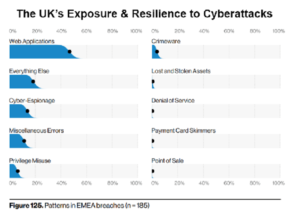
Source: Verizon’s 2020 Data Breach Investigations Report

Most notably, 2020 saw cybercriminals target outward-facing email servers, as well as business-critical applications.

Incidentally, 27 percent of malware incidents were ransomware, which Cybersecurity Ventures predicts will cause damage costs of £16 billion by 2021, equating to 57X more than it was in 2015 – making it the fastest-growing type of cyberattack.

The second tactic used – exploiting vulnerabilities – accounts for 20 percent of breaches in EMEA, where an attacker gains access to data or a system or repurposes a server for malicious intent. Checking external-facing websites or software for vulnerabilities, as well as missing security protocols, such as multi-factor authentication, is key to minimise your exposure. 

Surprisingly, it’s not just external threats you should be worried about but also internal. Internal actors account for 13 percent of all data breaches with 70 percent of all threat actors driven by financial gain, followed by espionage (22 percent).

Where do the cyberattacks originate From?

Since the very nature of cybercrime transcends international borders, cyber actors often mask their identity to remain completely anonymous which can make it difficult to identify those responsible for attacks. However, it has been reported by the National Cyber Security Centre that a significant number of incidents come from hostile nation-states.

One such example involved the infamous group Turla. Turla hijacked the systems of a rival Iranian APT (advanced persistent threat) allowing them to masquerade as Iranian hackers to cover their Russian origin while they executed malware attacks against UK entities.

More recently, the Lazarus Group, commonly believed to be run by the North Korean government, planned a large-scale campaign sending COVID-19-themed phishing emails to over 5 million businesses and individuals across six countries, including the UK.

The UK’s resilience to cyberattacks

The UK has the highest level of commitment to cybersecurity globally thanks to the three core objectives of the National Cybersecurity Strategy:

  1. Defend – Protect networks, data, and systems by ensuring that the UK can defend against new waves of cyberthreats, respond effectively to incidents, and provide citizens, businesses, and the public sector with the knowledge needed to employ the necessary security protocols.
  2. Deter – Make the UK a hard target by meticulously detecting, understanding, investigating, and disrupting all hostile actions taken against us, whilst also rigorously pursuing and prosecuting offenders. 
  3. Develop –  A combination of continued innovation through world-leading scientific research and development and maintaining a pipeline of talent to fill the skills needed to meet both the public and private sector needs will enable the UK to adeptly overcome the threats of an ever-changing cyber environment.

The UK is a prosperous digital nation and it will continue to attract the attention of attackers but with the £1.9 billion invested to defend, deter, and develop against cybercrime, the UK’s level of commitment to cybersecurity is set to stay at the top of the pack globally. However, global cooperation is required to make the digital world a safer place.

Contributed by Joshua Frisby, Founder of PasswordManagers.co. 

Share3Tweet
Previous Post

New technique designed to prevent medical imaging cyberthreats

Next Post

Come 2021 the cost of cybercrime per minute expected to hit $11.4 million

Recent News

Nagomi Control Brings CTEM Into Action

IT Security Guru picks for Infosecurity Europe 2026

June 1, 2026
Nine in Ten Security Leaders Concerned About AI-Generated Code Risks as Salt Security Launches New Governance Tool

Nine in Ten Security Leaders Concerned About AI-Generated Code Risks as Salt Security Launches New Governance Tool

June 1, 2026
Acumen Cyber and AttackIQ Partner to Strengthen Cyber Defense Validation

Acumen Cyber and AttackIQ Partner to Strengthen Cyber Defense Validation

May 29, 2026
Check Point Launches AI Agents That Think Like Attackers as Autonomous Exploitation Reaches Critical Threat Level

Check Point Launches AI Agents That Think Like Attackers as Autonomous Exploitation Reaches Critical Threat Level

May 28, 2026

The IT Security Guru offers a daily news digest of all the best breaking IT security news stories first thing in the morning! Rather than you having to trawl through all the news feeds to find out what’s cooking, you can quickly get everything you need from this site!

Our Address: 10 London Mews, London, W2 1HY

Follow Us

© 2015 - 2024 IT Security Guru - Website Managed by Dessol

  • About Us
Manage Consent
To provide the best experiences, we use technologies like cookies to store and/or access device information. Consenting to these technologies will allow us to process data such as browsing behavior or unique IDs on this site. Not consenting or withdrawing consent, may adversely affect certain features and functions.
Functional Always active
The technical storage or access is strictly necessary for the legitimate purpose of enabling the use of a specific service explicitly requested by the subscriber or user, or for the sole purpose of carrying out the transmission of a communication over an electronic communications network.
Preferences
The technical storage or access is necessary for the legitimate purpose of storing preferences that are not requested by the subscriber or user.
Statistics
The technical storage or access that is used exclusively for statistical purposes. The technical storage or access that is used exclusively for anonymous statistical purposes. Without a subpoena, voluntary compliance on the part of your Internet Service Provider, or additional records from a third party, information stored or retrieved for this purpose alone cannot usually be used to identify you.
Marketing
The technical storage or access is required to create user profiles to send advertising, or to track the user on a website or across several websites for similar marketing purposes.
  • Manage options
  • Manage services
  • Manage {vendor_count} vendors
  • Read more about these purposes
View preferences
  • {title}
  • {title}
  • {title}
No Result
View All Result
  • Home
  • Features
  • Insight
  • Channel News
  • Events
    • Most Inspiring Women in Cyber 2026
  • Topics
    • Cloud Security
    • Cyber Crime
    • Cyber Warfare
    • Data Protection
    • DDoS
    • Hacking
    • Malware, Phishing and Ransomware
    • Mobile Security
    • Network Security
    • Regulation
    • Skills Gap
    • The Internet of Things
    • Threat Detection
    • AI and Machine Learning
    • Industrial Internet of Things
  • Multimedia
  • Product Reviews
  • About Us

© 2015 - 2024 IT Security Guru - Website Managed by Dessol