
Eskenzi PR ad banner Eskenzi PR ad banner
  • About Us
Sunday, 21 June, 2026
IT Security Guru
Eskenzi PR banner
  • Home
  • Features
  • Insight
  • Channel News
  • Events
    • Most Inspiring Women in Cyber 2026
  • Topics
    • Cloud Security
    • Cyber Crime
    • Cyber Warfare
    • Data Protection
    • DDoS
    • Hacking
    • Malware, Phishing and Ransomware
    • Mobile Security
    • Network Security
    • Regulation
    • Skills Gap
    • The Internet of Things
    • Threat Detection
    • AI and Machine Learning
    • Industrial Internet of Things
  • Multimedia
  • Product Reviews
  • About Us
No Result
View All Result
  • Home
  • Features
  • Insight
  • Channel News
  • Events
    • Most Inspiring Women in Cyber 2026
  • Topics
    • Cloud Security
    • Cyber Crime
    • Cyber Warfare
    • Data Protection
    • DDoS
    • Hacking
    • Malware, Phishing and Ransomware
    • Mobile Security
    • Network Security
    • Regulation
    • Skills Gap
    • The Internet of Things
    • Threat Detection
    • AI and Machine Learning
    • Industrial Internet of Things
  • Multimedia
  • Product Reviews
  • About Us
No Result
View All Result
IT Security Guru
No Result
View All Result

New Report shows 55% of websites have severe vulnerabilities

by The Gurus
September 6, 2016
in Editor's News
Share on FacebookShare on Twitter

The Acunetix annual Web Application Vulnerability Report 2016 has found that high-severity vulnerabilities are on the rise and are now present in the majority of websites globally.
The report looked at 45,000 website and network scans done on 5,700 scan targets from April 2015 to March 2016. Results show that not only do 55% of websites have one or more high-severity vulnerabilities, but this has significantly deteriorated in just one year, growing by 9% over 2015’s report. In addition, 84% of web applications were found to have medium-severity vulnerabilities, while 16% of perimeter network assets were also susceptible to at least one medium severity vulnerability. While this research found a minor, but encouraging reduction in security vulnerabilities such as SQL injection and Cross-site Scripting, these web application vulnerabilities are just two of the top three. The second most prominent vulnerability is Vulnerable JavaScript Libraries (which open up a web app to XSS attacks) – this has shown a significant increase, more than doubling since last year.
On the other hand, Secure Shell (SSH) related vulnerabilities were found to be the most prominent perimeter network vulnerabilities.
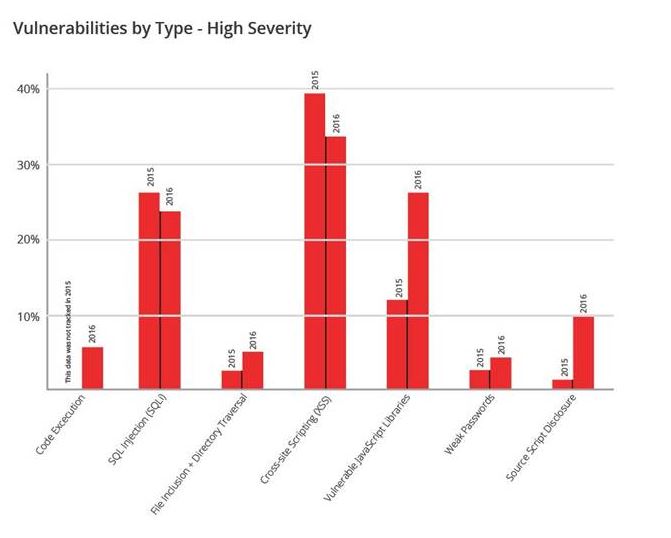
vulnerability chart
Vulnerabilities by type
Organisations are under intense pressure to deliver web apps and web services to meet the demands of modern digital customers. However, app security is not keeping pace with the development cycle, which broadens a brand’s threat surface. Therefore, today there are significantly more flaws for potential cyber attackers to exploit than 12 months ago.
Organisations need to be clear on what this means – a high-severity vulnerability could allow attackers to gain unauthorised access to data and systems, potentially to sensitive financial, customer, health data and trade secrets. They could also move to other systems to escalate the attack even further.
Chris Martin, General Manager at Acunetix, says: “Our research clearly shows high-severity web app flaws are on the rise and older vulnerabilities are still hanging around. Having a plan in place to prioritise these problems – and actually start tackling them – is critical. Using an automated vulnerability scanner such as Acunetix is the first step to protect your brand’s online real estate.”
Download the 2016 Web Application Security Report from: http://www.acunetix.com/acunetix-web-application-vulnerability-report-2016/

Tags: acunetixAppCyber Securityweb appweb application vulnerability
ShareTweet
Previous Post

Threat Alert: Cerber Ransomware v3 Spotted in the Wild

Next Post

HEAT Software First to be Awarded CESG CPA Accreditation for Software Execution Control

Recent News

AI Needs Human Expertise: How Securonix and Acora Are Transforming Security Operations

AI Needs Human Expertise: How Securonix and Acora Are Transforming Security Operations

June 19, 2026
75% of Organisations Have Gaps in Core Security Controls, Research Finds

More than 60% of Organisations Report Cyberattacks Spreading Beyond Email Into Teams, Slack and SMS, Finds New Research From KnowBe4

June 19, 2026
Frontline Workers Twice as Likely to Use Unapproved AI

VerifyLabs.AI Brings Deepfake Detection to Android After a recent IOS release

June 19, 2026
Proton removes the last barrier to leaving Google Workspace

Proton removes the last barrier to leaving Google Workspace

June 17, 2026

The IT Security Guru offers a daily news digest of all the best breaking IT security news stories first thing in the morning! Rather than you having to trawl through all the news feeds to find out what’s cooking, you can quickly get everything you need from this site!

Our Address: 10 London Mews, London, W2 1HY

Follow Us

© 2015 - 2024 IT Security Guru - Website Managed by Dessol

  • About Us
Manage Consent
To provide the best experiences, we use technologies like cookies to store and/or access device information. Consenting to these technologies will allow us to process data such as browsing behavior or unique IDs on this site. Not consenting or withdrawing consent, may adversely affect certain features and functions.
Functional Always active
The technical storage or access is strictly necessary for the legitimate purpose of enabling the use of a specific service explicitly requested by the subscriber or user, or for the sole purpose of carrying out the transmission of a communication over an electronic communications network.
Preferences
The technical storage or access is necessary for the legitimate purpose of storing preferences that are not requested by the subscriber or user.
Statistics
The technical storage or access that is used exclusively for statistical purposes. The technical storage or access that is used exclusively for anonymous statistical purposes. Without a subpoena, voluntary compliance on the part of your Internet Service Provider, or additional records from a third party, information stored or retrieved for this purpose alone cannot usually be used to identify you.
Marketing
The technical storage or access is required to create user profiles to send advertising, or to track the user on a website or across several websites for similar marketing purposes.
  • Manage options
  • Manage services
  • Manage {vendor_count} vendors
  • Read more about these purposes
View preferences
  • {title}
  • {title}
  • {title}
No Result
View All Result
  • Home
  • Features
  • Insight
  • Channel News
  • Events
    • Most Inspiring Women in Cyber 2026
  • Topics
    • Cloud Security
    • Cyber Crime
    • Cyber Warfare
    • Data Protection
    • DDoS
    • Hacking
    • Malware, Phishing and Ransomware
    • Mobile Security
    • Network Security
    • Regulation
    • Skills Gap
    • The Internet of Things
    • Threat Detection
    • AI and Machine Learning
    • Industrial Internet of Things
  • Multimedia
  • Product Reviews
  • About Us

© 2015 - 2024 IT Security Guru - Website Managed by Dessol