Eskenzi PR ad banner Eskenzi PR ad banner
  • About Us
Friday, 26 June, 2026
IT Security Guru
Eskenzi PR banner
  • Home
  • Features
  • Insight
  • Channel News
  • Events
    • Most Inspiring Women in Cyber 2026
  • Topics
    • Cloud Security
    • Cyber Crime
    • Cyber Warfare
    • Data Protection
    • DDoS
    • Hacking
    • Malware, Phishing and Ransomware
    • Mobile Security
    • Network Security
    • Regulation
    • Skills Gap
    • The Internet of Things
    • Threat Detection
    • AI and Machine Learning
    • Industrial Internet of Things
  • Multimedia
  • Product Reviews
  • About Us
No Result
View All Result
  • Home
  • Features
  • Insight
  • Channel News
  • Events
    • Most Inspiring Women in Cyber 2026
  • Topics
    • Cloud Security
    • Cyber Crime
    • Cyber Warfare
    • Data Protection
    • DDoS
    • Hacking
    • Malware, Phishing and Ransomware
    • Mobile Security
    • Network Security
    • Regulation
    • Skills Gap
    • The Internet of Things
    • Threat Detection
    • AI and Machine Learning
    • Industrial Internet of Things
  • Multimedia
  • Product Reviews
  • About Us
No Result
View All Result
IT Security Guru
No Result
View All Result

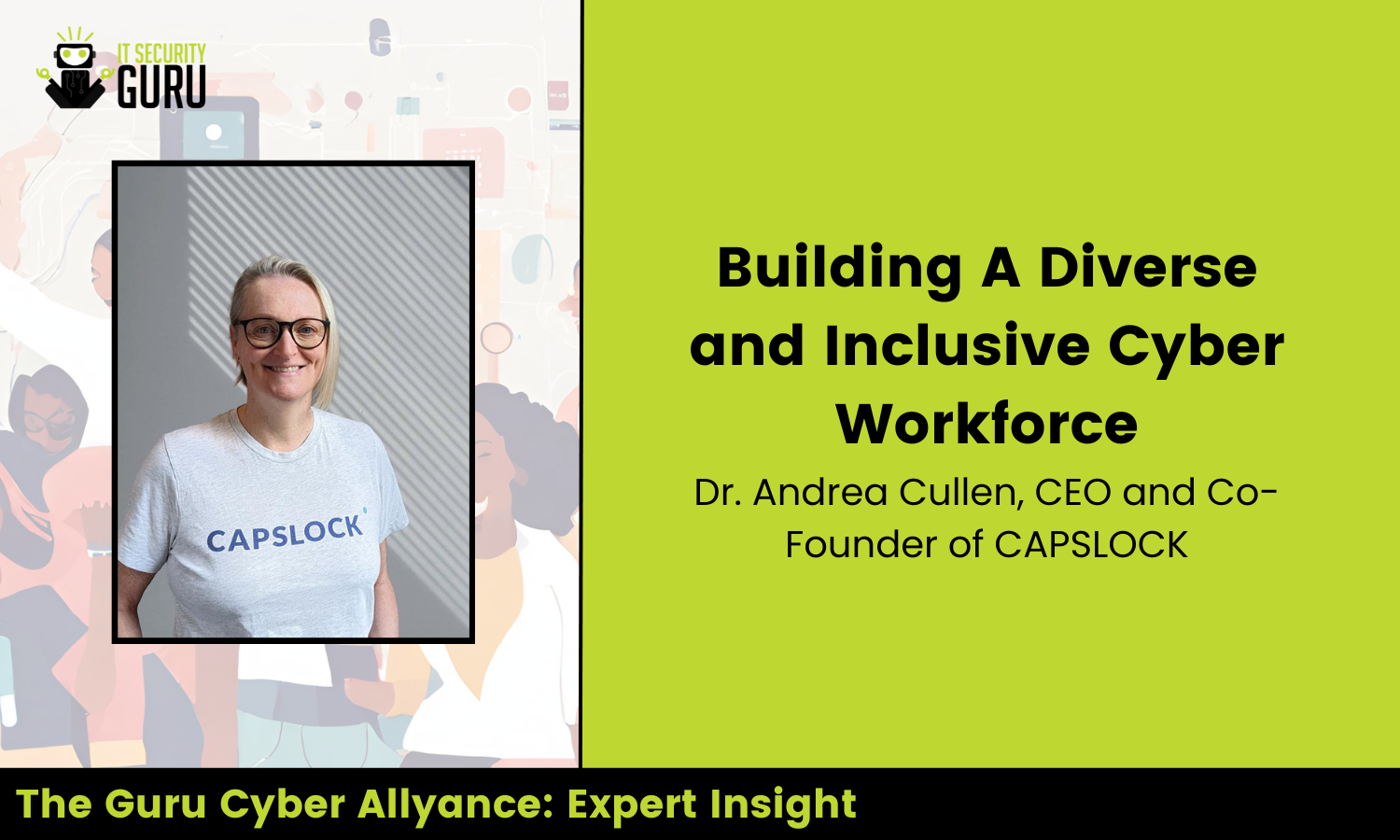
Building a diverse and inclusive cyber workforce

By Dr Andrea Cullen, Co-Founder, CAPSLOCK

by The Gurus
May 16, 2024
in The Guru Cyber Allyance
Dr Andrea Cullen
Share on FacebookShare on Twitter

At this month’s DTX Manchester, I’ll be taking part in a panel discussion around the importance of inclusion and diversity in cyber recruitment.

For far too long cyber security was seen as a man’s sport. Not only did men take up the majority of leadership roles in the industry, but they were the dominant force at all levels, from the SOC to the sales team.

Unsurprising, this earned the industry an image of a boy’s club, which has been difficult to shake, even today.

Fortunately, however, the industry is slowly waking up to the learning that strength lies in differences, not similarities.

To be truly resilient in today’s digital world, organisations benefit from varying perspectives, backgrounds and genders.

Cyber security is all about problem-solving. It was born out of IT, but it’s no longer just a technical nuisance. Today cyber incidents can shatter an organisation’s survival in minutes, while the impacts of attacks can harm customers, employees and physical processes.

As cyber moves away from its roots in IT, organisations are recognising that when recruiting into their security teams, technical qualifications are not the only prerequisite. Instead, they are bolstering their security teams with problem solvers, multi-taskers, born-leaders, each from varying backgrounds, not just previous roles in cyber.

They are also recognising that security teams need to be diverse to achieve cyber resilience. People must come from different backgrounds, genders and races to tackle the continuously evolving cyber challenges they face today.

When organisations do this, they are bolstered with teams who all approach a problem differently. Instead of looking at a problem and seeing only one solution, diverse teams bring numerous unique ideas, which innovates cyber defences and improves the security of a business.

Diverse teams also nurture inclusivity and encourage more people into the cyber profession. Which should, once and for all, eradicate the boy’s club image the industry has been tainted with. As more non-technical people see their peers enter the industry, they will see these people as role models. If they can do it, so can I.

At DTX Manchester, I will be providing organisations with my advice on how to diversify their cyber recruitment strategies.

I will explain how inclusive teams lead to more resilient organisations. Organisations shouldn’t just look at technical qualifications when hiring for cyber roles, the most innovative and resilient organisations are supported by teams with backgrounds in nursing, dancing, taxi driving, and stay-at-home parents. To tackle today’s evolving cyber threats, we need the perspectives of everyone in society, not just a subset.

Cyber criminals don’t operate by the same rule book, the only similarity they share is their desire to cause harm.

If we want to win the fight against them, we must diversify our pool of defenders – where we think differently, tackle problems uniquely and value the skills and opinions of all backgrounds.

Join me at DTX Manchester on Thursday 23rd May, to hear me participate in a session on how to build a resilient cyber workforce, where teams embrace neurodiversity and value different perspectives to help defend against today’s constantly evolving cyber threats.


ShareTweet
Previous Post

Public Sector IT is Broken: Turning the System Back On

Next Post

Advanced Cyber Defence Systems Joins Elite Group in Signing CISA’s Secure by Design Pledge

Recent News

UK Museums Are a Cyber Incident Waiting to Happen and the Government Knows It

UK Museums Are a Cyber Incident Waiting to Happen and the Government Knows It

June 25, 2026
pqc

New Forescout Data Reveals Slow Progress Toward Quantum-Safe Security

June 24, 2026
AI-Powered Phishing Attacks Surge 1,380% as Criminal Platforms Render MFA Obsolete

AI-Powered Phishing Attacks Surge 1,380% as Criminal Platforms Render MFA Obsolete

June 24, 2026
Security Training Needs Google Maps, Not Christopher Columbus

Security Training Needs Google Maps, Not Christopher Columbus

June 24, 2026

The IT Security Guru offers a daily news digest of all the best breaking IT security news stories first thing in the morning! Rather than you having to trawl through all the news feeds to find out what’s cooking, you can quickly get everything you need from this site!

Our Address: 10 London Mews, London, W2 1HY

Follow Us

© 2015 - 2024 IT Security Guru - Website Managed by Dessol

  • About Us
Manage Consent
To provide the best experiences, we use technologies like cookies to store and/or access device information. Consenting to these technologies will allow us to process data such as browsing behavior or unique IDs on this site. Not consenting or withdrawing consent, may adversely affect certain features and functions.
Functional Always active
The technical storage or access is strictly necessary for the legitimate purpose of enabling the use of a specific service explicitly requested by the subscriber or user, or for the sole purpose of carrying out the transmission of a communication over an electronic communications network.
Preferences
The technical storage or access is necessary for the legitimate purpose of storing preferences that are not requested by the subscriber or user.
Statistics
The technical storage or access that is used exclusively for statistical purposes. The technical storage or access that is used exclusively for anonymous statistical purposes. Without a subpoena, voluntary compliance on the part of your Internet Service Provider, or additional records from a third party, information stored or retrieved for this purpose alone cannot usually be used to identify you.
Marketing
The technical storage or access is required to create user profiles to send advertising, or to track the user on a website or across several websites for similar marketing purposes.
  • Manage options
  • Manage services
  • Manage {vendor_count} vendors
  • Read more about these purposes
View preferences
  • {title}
  • {title}
  • {title}
No Result
View All Result
  • Home
  • Features
  • Insight
  • Channel News
  • Events
    • Most Inspiring Women in Cyber 2026
  • Topics
    • Cloud Security
    • Cyber Crime
    • Cyber Warfare
    • Data Protection
    • DDoS
    • Hacking
    • Malware, Phishing and Ransomware
    • Mobile Security
    • Network Security
    • Regulation
    • Skills Gap
    • The Internet of Things
    • Threat Detection
    • AI and Machine Learning
    • Industrial Internet of Things
  • Multimedia
  • Product Reviews
  • About Us

© 2015 - 2024 IT Security Guru - Website Managed by Dessol