Eskenzi PR ad banner Eskenzi PR ad banner

Scam Of The Week

With Christmas fast approaching and Boxing day and January sales still to come, cybercriminals will be preparing to cash in on this busy period with targeted online scams which could ruin the festive fun. These scams could include anything from impersonating parcel delivery services to running ‘too good to be true’ online offers leading to malicious websites, as well as fake refunds and text phishing. According to the Norton Cybersecurity Insights Report: Among those who...

Read moreDetails
scam

The ongoing war in Syria has seen the number of fraudulent emails targeting the international community rise in recent months, according to a Kaspersky Lab report into spam and phishing trends. Widespread media coverage has increased international interest in the plight of Syrian citizens, and this has led Nigerian scammers to jump on the bandwagon and exploit the kindness of strangers looking to help those affected by events in the Middle East.  Most emails claim...

Read moreDetails

An investigation by Symantec has revealed a growing number of incidents involving fake LinkedIn accounts targeting members of the social network. Symantec has worked with LinkedIn to take down some fake accounts that were uncovered during their research, in which scammers were scraping contact information from users. The primary goal of the fake LinkedIn accounts, posing as recruiters, is mapping business professionals’ networks and establish a sense of credibility in order to reach more people....

Read moreDetails

Cyber criminals have used the recent terror attacks as fuel for terror-alert spear phishing emails. The emails which read like a warning from the law enforcement officials in Dubai, Bahrain, Turkey, and Canada, bank on users’ fear of terror attacks to trick them into executing the malicious attachments. The attachments, containing Backdoor.Sockrat, are disguised as valuable security tips that could help recipients to protect themselves, as well as their companies and their families, from potential...

Read moreDetails

PhishMe’s Research Team has today warned of a phishing message circulating, supposedly from someone seeking employment. However, instead of just spelling mistakes or perhaps grammatical errors, the attachment is far more sinister as it contains Ransomware. Ronnie Tokazowski – Senior Researcher at PhishMe explains, “Often November is a busy time for UK employers as graduates, returning from post-university summer breaks, start actively seeing employment. While the message itself is extremely vague, the fact that it...

Read moreDetails

Amazon themed malware targets Crypto Currency By Troy Gill, manager of security research at AppRiver Over the past week we have been monitoring (and blocking) a stream of malicious emails attempting to pose as legitimate Amazon purchase confirmations. The messages simply state that your order has been confirmed and contains a small amount of details. The user being target is directed to the attached .doc file for the shipping and tracking details. In order for the .doc...

Read moreDetails

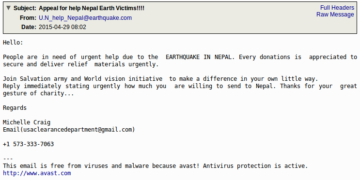
Researchers have identified scam emails circulating claiming to be part of relief funds for the recent earthquake in Nepal. Web and email security company AppRiver identified emails disguised as news updates, appeals for donations and emails claiming to be part of relief funds. Jonathan French, security analyst, AppRiver said “We’ve been seeing a slow influx of messages mentioning the earthquake as an attention getter for normal spam. We’ve also seen customized 419 scam messages coming...

Read moreDetails

Ahead of the long-awaited fight in a couple of weeks between Floyd Mayweather Jr and Manny Pacquiao, a Facebook scam is using Mr Pound for Pound as the theme of a Facebook scam.   According to Softpedia cyber crooks have set up a page impersonating the boxing champion to advertise the fact that he is giving away colossal sums of money to randomly selected fans. Called MayweatherHQ, it has absolutely no affiliation with the champ....

Read moreDetails
iPhone scam

Cyber criminal gangs from Asia are using advanced Android apps that can steal private data and record conversations for sex extortion – or sextortion – and blackmail.   The attacks originate from South Korea and Japan have evolved to using malicious mobile apps to steal personal data and intercept text messages and phone calls.   According to a new report by cyber security researchers from Trend Micro, cyber criminals routinely make fake profiles on social...

Read moreDetails
Page 3 of 6 1 2 3 4 6