Eskenzi PR ad banner Eskenzi PR ad banner
  • About Us
Tuesday, 16 June, 2026
IT Security Guru
Eskenzi PR banner
  • Home
  • Features
  • Insight
  • Channel News
  • Events
    • Most Inspiring Women in Cyber 2026
  • Topics
    • Cloud Security
    • Cyber Crime
    • Cyber Warfare
    • Data Protection
    • DDoS
    • Hacking
    • Malware, Phishing and Ransomware
    • Mobile Security
    • Network Security
    • Regulation
    • Skills Gap
    • The Internet of Things
    • Threat Detection
    • AI and Machine Learning
    • Industrial Internet of Things
  • Multimedia
  • Product Reviews
  • About Us
No Result
View All Result
  • Home
  • Features
  • Insight
  • Channel News
  • Events
    • Most Inspiring Women in Cyber 2026
  • Topics
    • Cloud Security
    • Cyber Crime
    • Cyber Warfare
    • Data Protection
    • DDoS
    • Hacking
    • Malware, Phishing and Ransomware
    • Mobile Security
    • Network Security
    • Regulation
    • Skills Gap
    • The Internet of Things
    • Threat Detection
    • AI and Machine Learning
    • Industrial Internet of Things
  • Multimedia
  • Product Reviews
  • About Us
No Result
View All Result
IT Security Guru
No Result
View All Result

HR and IT related phishing scams still most popular according to KnowBe4’s latest Phishing Report

KnowBe4’s Q1 2024 global phishing report finds that HR and IT related email subjects account for more than 42% and 30% of top phishing email subjects respectively

by Guru Writer
May 21, 2024
in Editor's News, Featured
HR and IT related phishing scams still most popular according to KnowBe4’s latest Phishing Report
Share on FacebookShare on Twitter

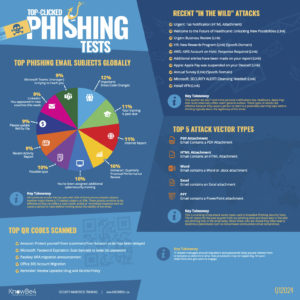
KnowBe4, the provider of the world’s largest security awareness training and simulated phishing platform, has revealed the results of its Q1 2024 top-clicked phishing test report. The results include the most common email subjects clicked on in phishing tests, reflecting the persistent use of HR or IT-related business email messages that captivate employees’ interests.


HR-related phishing attacks take the top spot at 42%, a trend that has persisted for the last three quarters, followed by IT-related phishing emails at 30%. Phishing emails from HR or IT departments that prompt dress code changes, tax and healthcare updates, training notifications and other similar actions are effective in deceiving employees as they can affect a user’s work, evoke an immediate response and can cause a person to react before thinking about the validity of the email.


The KnowBe4 phishing report this quarter also noted more personal phishing email attacks, such as tax, healthcare and ApplePay, that could affect users’ sensitive information. These types of attacks are effective because they cause a person to react to a potentially alarming topic and engage to protect their private information before thinking logically about the credibility of the email.


Phishing emails continue to be one of the most common methods for executing cyberattacks on organisations worldwide. KnowBe4’s 2023 Phishing by Industry Benchmarking Report showed that nearly one third of users are susceptible to clicking on malicious links or complying with fraudulent requests. As a result, cybercriminals take advantage of this vulnerability and leverage the innovative tools available to them, such as AI, to come up with increasingly sophisticated messages to outsmart users. These bad actors tailor phishing email strategies to appear more legitimate in their requests and trick employees by inciting an emotional response and urgency to click on a malicious link or download an infected attachment.


“KnowBe4’s report shows that cybercriminals are becoming increasingly tactical in exploiting employee trust by using HR-related phishing emails due to their seemingly legitimate source,” said Stu Sjouwerman, CEO of KnowBe4. “Emails coming from an internal department such as HR or IT are especially harmful to organisations since they appear to be coming from a trusted source and can convince employees to engage quickly before confirming their legitimacy, exposing the company to security vulnerabilities. A well-trained workforce is therefore crucial in building a strong security culture and serves as the best defence in safeguarding organisations against preventable cyberattacks.”
 

ShareTweet
Previous Post

With a startup’s assist, the UK Government publishes new AI security guidelines

Next Post

Transform Your Google Slides: Tips from Experts for Eye-Catching Decks

Recent News

KnowBe4 Appoints Alex Callihan as Chief Technology Officer

KnowBe4 Appoints Alex Callihan as Chief Technology Officer

June 16, 2026
One Copied Command. Eleven Compromised Machines. Inside a ClickFix Attack That Took Over an Entire Network

One Copied Command. Eleven Compromised Machines. Inside a ClickFix Attack That Took Over an Entire Network

June 16, 2026
AI Appreciation Day: Celebrating Progress, Embracing Responsibility

AI-Powered Attackers Force Security Teams to Rethink Speed of Response

June 16, 2026
US Tech Dependence Is Becoming a Data Security Risk; and Consumers Are Waking Up to It

US Tech Dependence Is Becoming a Data Security Risk; and Consumers Are Waking Up to It

June 16, 2026

The IT Security Guru offers a daily news digest of all the best breaking IT security news stories first thing in the morning! Rather than you having to trawl through all the news feeds to find out what’s cooking, you can quickly get everything you need from this site!

Our Address: 10 London Mews, London, W2 1HY

Follow Us

© 2015 - 2024 IT Security Guru - Website Managed by Dessol

  • About Us
Manage Consent
To provide the best experiences, we use technologies like cookies to store and/or access device information. Consenting to these technologies will allow us to process data such as browsing behavior or unique IDs on this site. Not consenting or withdrawing consent, may adversely affect certain features and functions.
Functional Always active
The technical storage or access is strictly necessary for the legitimate purpose of enabling the use of a specific service explicitly requested by the subscriber or user, or for the sole purpose of carrying out the transmission of a communication over an electronic communications network.
Preferences
The technical storage or access is necessary for the legitimate purpose of storing preferences that are not requested by the subscriber or user.
Statistics
The technical storage or access that is used exclusively for statistical purposes. The technical storage or access that is used exclusively for anonymous statistical purposes. Without a subpoena, voluntary compliance on the part of your Internet Service Provider, or additional records from a third party, information stored or retrieved for this purpose alone cannot usually be used to identify you.
Marketing
The technical storage or access is required to create user profiles to send advertising, or to track the user on a website or across several websites for similar marketing purposes.
  • Manage options
  • Manage services
  • Manage {vendor_count} vendors
  • Read more about these purposes
View preferences
  • {title}
  • {title}
  • {title}
No Result
View All Result
  • Home
  • Features
  • Insight
  • Channel News
  • Events
    • Most Inspiring Women in Cyber 2026
  • Topics
    • Cloud Security
    • Cyber Crime
    • Cyber Warfare
    • Data Protection
    • DDoS
    • Hacking
    • Malware, Phishing and Ransomware
    • Mobile Security
    • Network Security
    • Regulation
    • Skills Gap
    • The Internet of Things
    • Threat Detection
    • AI and Machine Learning
    • Industrial Internet of Things
  • Multimedia
  • Product Reviews
  • About Us

© 2015 - 2024 IT Security Guru - Website Managed by Dessol