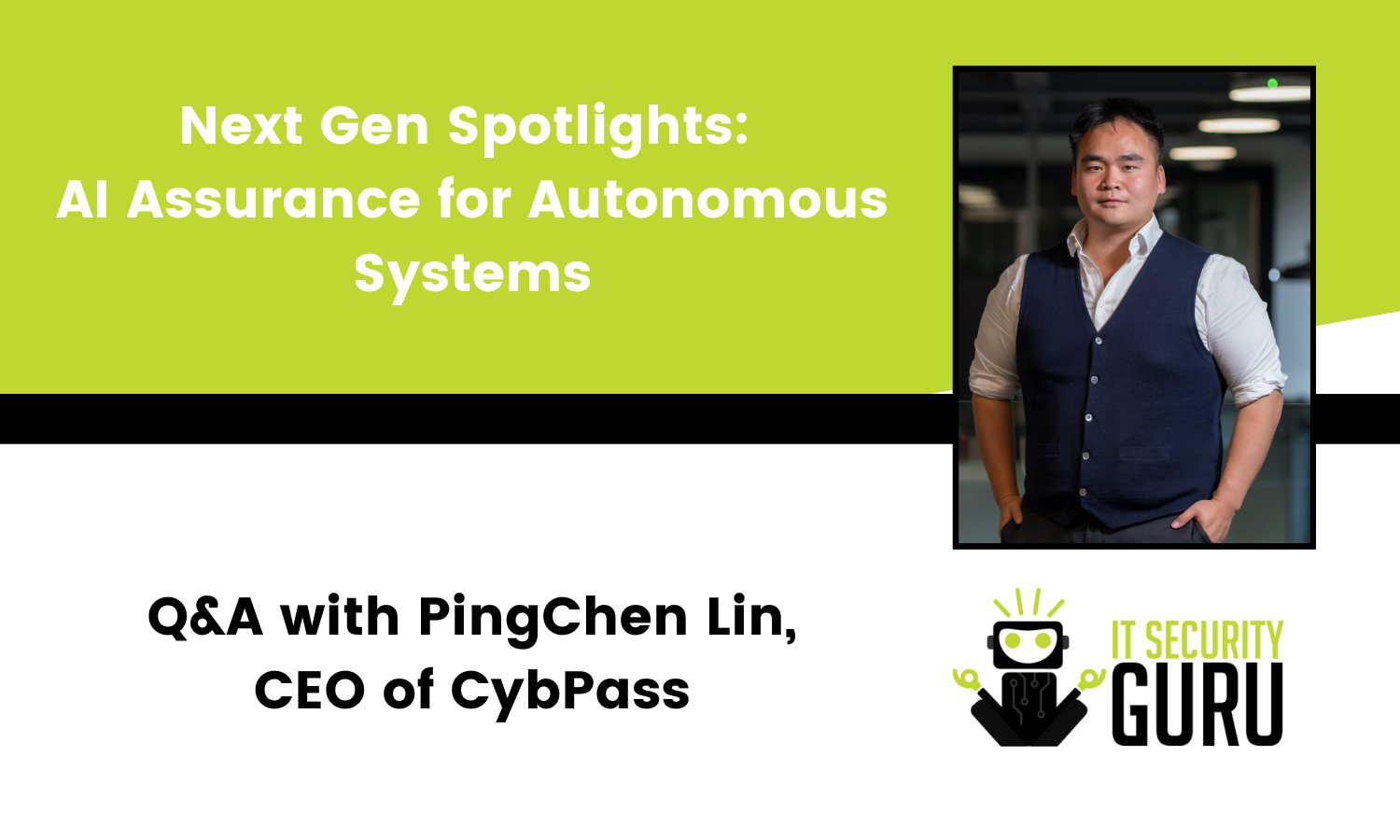
CybPass is on a mission to ensure that autonomous systems, from drones and robotics to self-driving vehicles, are safe, secure and ready for real-world deployment. In an era of fast, AI-driven automation, this is becoming increasingly important.

We spoke with co-founder and CEO PingChen Lin about turning academic research into a commercial venture, the unique problem his company is solving, and the lessons he’s learned along the
Tell us about yourself and CybPass
“I’m Ping-Chen Lin, co-founder and CEO of CybPass. I founded the company at 23, and became one of the youngest recipients of the EPSRC IAA Commercialisation Fellowship, as well as the first cybersecurity spin-out from the University of Sheffield led by one of its youngest founders.”
“My background spans computer science at Sheffield and marketing at LSE. That combination shaped how I build companies—deep technology, but always focused on real-world impact and adoption.”
“Sheffield is also where I met my co-founder and early team. What began as AI security research quickly became much bigger—we saw a clear gap in how AI systems are secured and assured in practice.”
“I didn’t follow a traditional career path, but I had a very clear vision. That clarity helped me attract senior, experienced co-founders and early team members who believed in the problem as strongly as I did.”
“We received our first funding through CyberASAP (Cyber Security Academic Startup Accelerator Programme), which is where CybPass truly started. Since then, external recognition and early customer engagement have validated our direction, but what really defines CybPass is the ambition to rethink AI assurance and security as these systems scale.”
CyberASAP, which is funded by the UK Government Department for Science, Innovation and Technology (DSIT) and delivered by Innovate UK, is a commercialisation programme that brings together industry-engaged academic teams developing cutting-edge cyber innovations with potential industry partners and cyber professionals. The programme provides an early engagement opportunity for organisations looking to source, incorporate or license new cyber products and services, while supporting academics to shape market-ready solutions with real-world impact.
What problem does your technology solve, and why does it matter right now?
“The problem we solve is that modern autonomous systems are now fundamentally stacks of AI—multiple models, data pipelines, and continuous updates operating together. As AI adoption accelerates in automotive and other safety-critical industries, these systems are becoming exponentially more complex, but the way we secure and assure them hasn’t evolved at the same pace.”
“Autonomous systems still have to comply with strict regulations and standards, but those frameworks were designed for static, deterministic software. They were never built for continuously learning, evolving AI pipelines. As a result, security and assurance today are largely manual, slow, and fragmented—and they simply don’t scale with the reality of AI-driven systems.”
“This matters right now because AI is moving from pilots into production. Autonomous systems are being deployed at scale, regulators are increasing scrutiny, and companies can’t afford assurance processes that break every time the AI changes. CybPass exists to make AI security and assurance continuous, automated, and aligned with how these systems actually evolve.”
How did CyberASAP help you turn academic research into a commercial product or company?
The CyberASAP programme operates in two phases. Phase 1 of CyberASAP supports researchers in developing and validating the commercial value of their cyber security ideas through structured value proposition and market validation activities over several months. Successful teams can progress to Phase 2, which provides funding and support to develop a proof of concept and accelerate their project toward market readiness
“CyberASAP is not only a programme – it’s more like a framework that teaches you how to commercialise academic research, and you can reuse that framework again and again.”
“The value proposition work was extremely helpful for us in identifying what problem we’re solving and how we solve it differently. Phase One really helped us communicate our idea clearly to customers, investors, and other stakeholders.”
“Phase Two really accelerates your skill set, with pitching to investors, running sales meetings and engaging with customers. It’s very practical. You’re not just building a concept – you’re proving that you’re solving a real problem.”
“Without CyberASAP, I don’t think we would have built this business in the way we have. It’s been fundamental to CybPass.”
What advice would you give to people in the current cohort or those thinking of applying?
“Don’t just treat this as a grant. This opportunity could genuinely change your life.”
“If you’re accepted, it means you’re proposing something with real potential, so treat it seriously and show real motivation.”
“Attend all the sessions, listen carefully, and actually apply what you learn… If you learn how to run a sales meeting, go out and run those sales meetings. Validate the learning in the real world.”
“CyberASAP is especially powerful for people who truly want to build a business, not just complete a funded academic project.”
What’s next for CybPass? Where do you hope to be in 12 months’ time?
“Our goal for the next 12 months is to prove product–market fit by closing paid pilots and converting them into longer-term contracts.”
“We want to close paid pilots consistently, scale our early adopters, and prepare for our next fundraising round.”
“Our customer base is already global – across Europe, APAC, and the US – and that gives us a strong foundation to expand further.”
CybPass will be at CyberASAP’s Demo Day as part of the alumni showcase on the 25th February 2026 in London. CyberASAP Demo Day also features the 14 final teams in this year’s cohort who will be pitching and demonstrating their proofs of concept. Find out more and register to attend here.